Constraining How the Voynich Manuscript Was Written Without Claiming What It Says
What holds up when we test published Voynich statistical claims, paleographic transcriptions, scan-aligned word geometry, and candidate production mechanisms across held-out quires.
- Kind
- Result, measured by the author
- Published
Every few months a new paper or preprint proposes either a plaintext reading of the Voynich manuscript (Yale Beinecke MS 408) or a simple mechanical generator that reproduces one of its famous statistical anomalies. When you test those proposals on the whole manuscript, two problems recur:
- In-sample tuning: A cipher key, anagram table, or slot grammar is fitted on the same pages used to score it, or evaluated on only one summary statistic (such as conditional character entropy
h_2or Zipf word-frequency slopes). - Protocol drift across papers: One study concatenates words across line breaks while another stays within lines; one drops non-ASCII lines and collapses EVA ligatures while another uses raw tokens; one measures
voynichese.comgrid boxes as if they were physical ink gaps.
I directed the team (the AI coding and research agents I direct) to run a controlled structural investigation across three independent transliterations (ZL3b-n, RF1b-e, and IT2a-n), 223 Beinecke TIFF folio scans, and a 15-quire leave-one-quire-out (LOQO) evaluation (s1 through s106, summarized in F-01 through F-47).
The full illustrated project page is at /work/voynich/ and the complete findings and protocol reconciliation index is at /evidence/voynich/. Here is what the evidence shows, what we corrected along the way, and where every tested model still breaks.
1. What prior literature established vs what we measured
Nothing in our work claims first discovery of the manuscript’s slot grammar, line anomalies, or low character entropy. Those ingredients come from decades of work by Currier, Jorge Stolfi (2000), Sravana Reddy and Kevin Knight (2011), Marco Ponzi (2019), Lisa Fagin Davis (2020), Claire Bowern and Luke Lindemann (2020/2021), Daniel Gaskell and Claire Bowern (2022), Maurizio Zattera (2022), contributors to the September 5, 2025 voynich.ninja thread, and Liudmila Rozanova and Alexander Temerev (2026 preprint).
Our contribution is joint quantitative ablation and out-of-sample protocol bridging:
- Physical lines are compositional units (
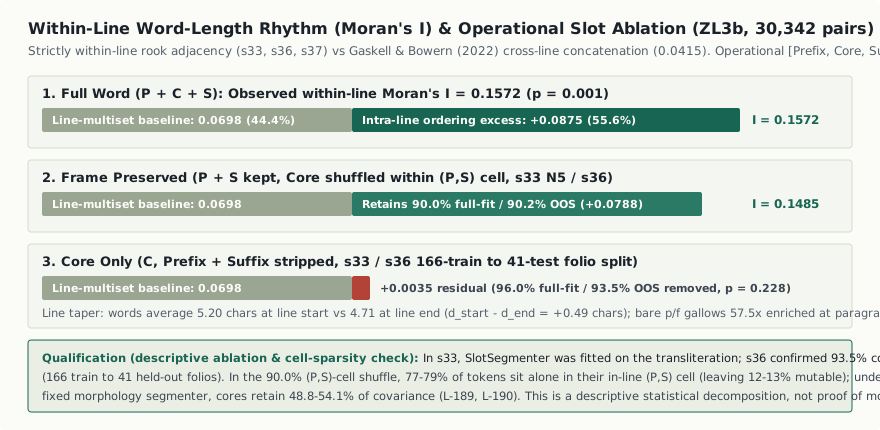
F-12,F-18,F-21,s33,s35,s36,s37): Gaskell and Bowern’s (2022)stats.pyconcatenated ~200-word subsamples across line breaks with rook weightw = 1, yieldingI = 0.0415. Measuring strictly within lines across all 30,342 adjacent word pairs givesI_within = 0.1572(44.4% line-multiset baseline + 55.6% intra-line ordering excess,p = 0.001). Extending Ponzi’s (2019) test across 223 folios (s35), true line ends carry 17.70%-m/-gmarkers and line starts carry 22.32% gallows, whereas internal<->plant-drawing interruptions (n = 744) drop to 2.82% and 0.27%. - Descriptive slot localization (
F-12,F-14,s33,s36,L-189,L-190): Under our operational[Prefix, Core, Suffix]segmenter (SlotSegmenter), stripping prefixes and suffixes toCore_Only(C)removes 96.0% of full-fit within-line word-length ordering excess and 93.5% of held-out length covariance (166 training folios to 41 held-out folios). Important qualification: becauseSlotSegmenteris a statistical decomposition fitted on the transliteration, this is a descriptive ablation, not a causal explanation or proof of linguistic morphemes. In the 90.0%(P, S)cell shuffle, 77% to 79% of tokens sit alone in their in-line(P, S)cell (leaving 12% to 13% mutable), and under a fixed morphology segmenter cores retain 48.8% to 54.1% of length covariance. - Inter-word prefix coupling and within-word 12-slot coupling (
F-06,F-15,F-35,s34,s63,s69,s76): Across adjacent words inside a line, positive pairwise mutual information excess concentrates on the next word’s prefix (+0.3171bits acrossP1->P2,C1->P2, andS1->P2, compared with+0.3683positive-cell sum and+0.3190signed grid sum; because the nine pairwise MI cells overlap, neither ratio is a share of total sequential information). Core-to-coreC1->C2sits-0.0315bits below within-line shuffle on the full 1,860-core inventory due to short-range core repetition and sparsity, not negative MI or meaninglessness; at matched inventory size (K = 200,s80), common cores carry weak positive sequential order. Within words, Zattera’s (2022) 12-slot grammar treated as independent slots has entropy sum16.71bits vs empirical word entropy11.06bits (5.65bits of cross-slot coupling,EXT-ZAT-2022,s63,s76). - Four-decimal reconciliation with Rozanova & Temerev 2026 (
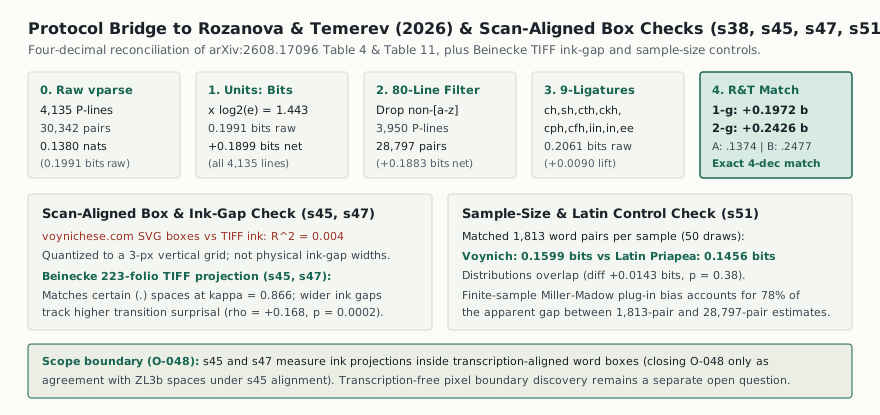
F-03,F-19,s38,s45,s47,s51): Converting our rawvparseboundary MI (0.1380nats on 4,135 lines) to bits, dropping 80 non-[a-z]lines (28,797pairs), collapsing 9 EVA ligatures, and subtracting 100 within-line shuffles reproduces R&T’s Table 4 (+0.19721-glyph,+0.24262-glyph) and Table 11 (+0.1374Currier A,+0.2477Currier B) to four decimal places. However,s47showsvoynichese.comSVG boxes are quantized to a 3-pixel grid (R^2 = 0.004vs Beinecke TIFF ink gaps), ands51shows that at matched sample size (1,813pairs), Voynich (0.1599bits) overlaps Latin Priapea (0.1456bits,p = 0.38).
2. Consequential corrections we made during the audit
Following our editorial rule to keep consequential corrections in the public record:
- Scribe vs section deconfounding (
s60,s77): BroadDavis Hand (1 to 5) x Currier Language (A/B)differences are real across the manuscript (JSD = 0.0253,p = 0.0002), but within the same section (Herbal-B, tested ins77under nested LOLO/LOBO/LOQO,c-510,L-305) the apparent grammatical divergence between Hand 2 and Hand 3 disappears; section and quire mixture explain that gap. - Volunteer gibberish corpus size (
n7): Gaskell and Bowern’s volunteer gibberish benchmark has 38 writers (10,023tokens). Our local 64 sidecar files include pooled and variant files rather than 64 independent corpora, and family X-vs-L counts are sample-size dependent at79to480tokens per document. - Recipe paragraph count (
s52), pre-registration audit rejections (D-064,D-065), ands96provenance: Fixing a locus-parser bug that readf102r1as folio 1021 corrected the Q20 recipe corpus from 295 to 285ZL3bparagraphs (its non-formulaic incipit result held). Under our pre-registration audit rules,s93(P-25) was rejected as a unified generator pass (D-064) and upstreams96(P-28) was rejected after a post-freeze threshold overwrite (D-065), while the separate Daybreak workspace’sdb-s96forward-tail audit ands112tos121runs are tracked separately as user-supplied reported evidence.
3. Why the manuscript remains undeciphered
Every familiar single-mechanism family we tested breaks on held-out quires:
- Per-word Naibbe and homophonic/verbose ciphers (
H-02toH-04,s24,s69,s84,s102,s104): Miss within-line prefix memory (F-24!), conditional character entropyh_2, or word-length rhythm (F-35,F-39). Period-documented ciphers (substitution+nulls, homophonic+nulls, 200-word nomenclators, line-held nomenclators) over Latin, Italian, and German recipes fail0/12cells (F-45,s102), and spec-built verbose table encodings of real recipe text fail0/18cells (F-47,s104). - Line-held sticky tables (
H-14, narrowed underD-067,s81,s98): Match 1-step prefix memory (F-38), but their core streams fail 15-quire LOQO0/15(F-34) and their conditional lag-2 prefix dependence is roughly2.5to3times higher than Voynich (10 to 12 / 15quires vs4 to 5 / 15ins98,F-46). - Table-and-grille (
H-05,s71) and self-citation (H-07,s66,s83): Weakened grilles fail LOQO0/15(F-26!); self-citation misses edge coupling or inflates core-length autocorrelationI_core(F-23). - Our closest multi-layer synthetic producer (
s93, rejected as a unified pass underD-064): Still overproduces short-range core recurrence by roughly2.6x. - External semantic & crib tests (
s29,s35,s92,s99,s103,s106, and user-supplied Daybreaks112tos121): Zodiac star angles (z = 0.00, p = 0.488), herbal rare-core plant features (p = 0.895), Penn LJS 419 / BL Sloane 4016 herbal runs (s103,INCONCLUSIVE), recipe star-color alternation (s106,HOLDat17/277), pharmaceutical container/visual similarity (20/31vs null median20/31), and Antidotarium Nicolai order-free recipe networks all return null or negative.
Read the full illustrated case study at /work/voynich/ or inspect the complete F-01 to F-47 and Matrix-v2 reconciliation index at /evidence/voynich/.